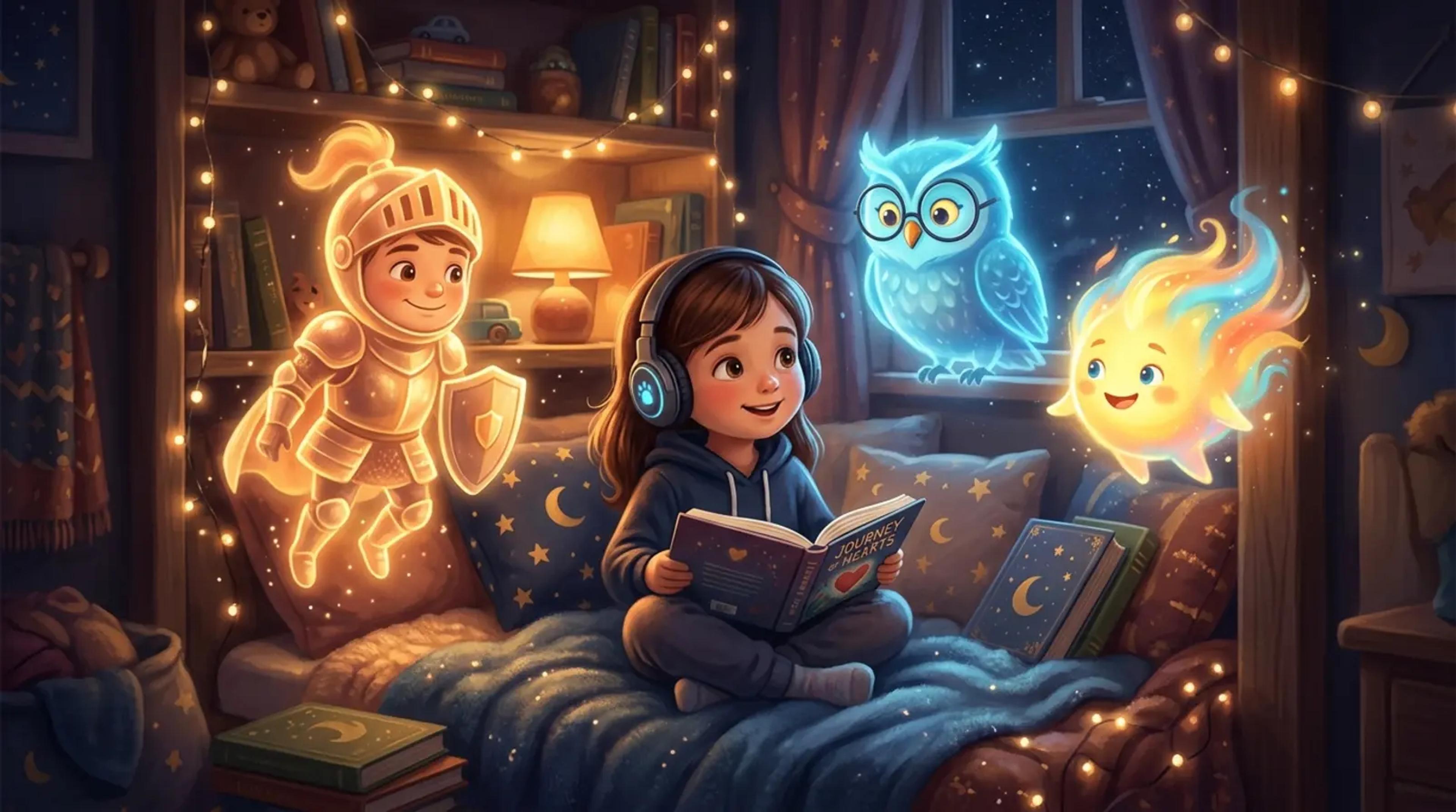
The 'Inner-Cast' Protocol: How Personalized Audio Stories Turn 'Big Feelings' into a Heroic Team of Parts
•Written by AudioFables Team
Key Takeaways:
► Emotions are internal 'parts' of a child, not their entire identity.
► Externalizing feelings into story characters makes complex emotions safe to explore.
► Personalized audio allows for a dynamic 'internal cast' that evolves with your child.
► This method builds emotional granularity and reduces meltdowns through 'Self-leadership.'
Have you ever heard your child say, 'A part of me wants to share, but a part of me is really mad'? If so, your child is already practicing what psychologists call 'Parts Work' or Internal Family Systems (IFS). In 2025, this clinical concept has exploded into mainstream parenting, thanks in part to the cultural shift toward emotional granularity. The core idea is simple: we aren't just one thing. We are a collection of 'parts'—the brave part, the shy part, the angry part—and a central 'Self' that can lead them all.
While tools like Slumberkins use physical plushies to represent feelings, they are often limited to a fixed set of characters. Your child’s 'angry part' might not look like a hammerhead shark; it might look like a roaring dragon or a tiny, buzzing bee. Static audio platforms like Toniebox or Yoto offer wonderful stories, but they can't adapt to the specific 'internal cast' your child is currently navigating.
Turn your child's favorite characters into personalized audio adventures. Sign up for free and start your story today!
Get Started FreeThe 'Inner-Cast' Protocol uses personalized AI-generated audio stories to turn these internal parts into a heroic team. Here is how you can implement it tonight:
1. Identify the 'Parts': Listen for the feelings your child is struggling with. Is there a 'Worry Wizard' or a 'Bossy Bear'?
2. Name the Protagonists: In AudioFables, create a story where these specific characters are the child's 'Inner Team.'
3. The Heroic Mission: Narrate a story where the child (the 'Self') helps these parts work together to solve a problem. For example, the 'Brave Knight' holds the hand of the 'Scared Squirrel' so they can cross a bridge together.
By using audio to externalize these feelings, you provide a 'safe distance.' When a child hears a story about their own 'Angry Dragon' learning to take deep breaths, they aren't being lectured; they are watching a teammate grow. This is the foundation of —the ability to see oneself as the hero of a complex, evolving story rather than a victim of overwhelming emotions.
With AudioFables, you can update this cast as your child grows. Today’s 'Toddler Tantrum Tiger' becomes tomorrow’s 'Tween Tension Transformer.' You aren't just telling a story; you are giving them the tools for a lifetime of mental well-being.