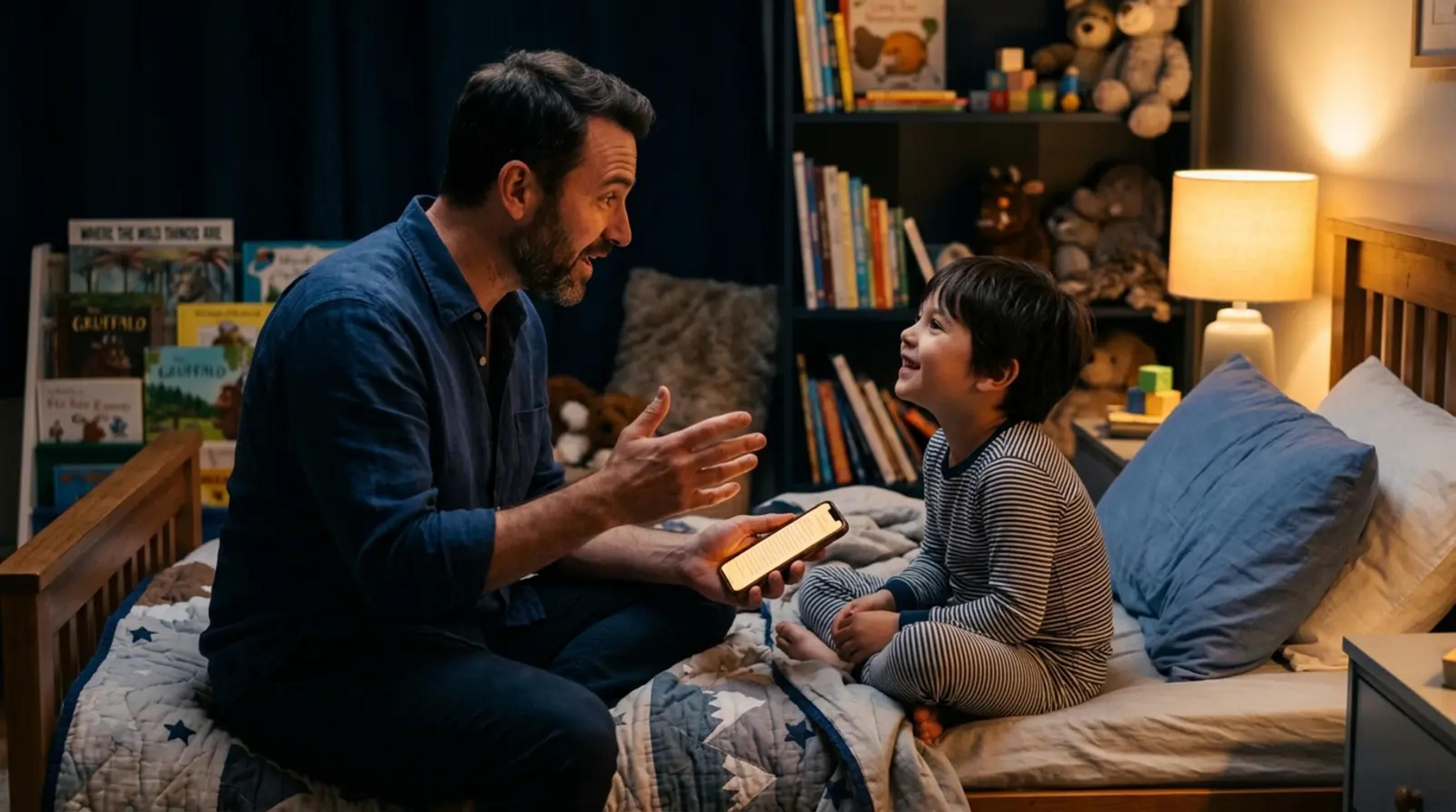
The Father-Narrator Effect: Unlocking Abstract Thinking Through Paternal Storytelling
•Written by AudioFables Team
Key Takeaways:
► Fathers tend to use 'decontextualized language,' which bridges the gap to abstract reasoning.
► Activation Theory suggests paternal storytelling builds risk-tolerance and persistence.
► Emotional expression during stories is the top predictor of future literacy.
► AudioFables empowers fathers to be 'Architects' of stories without the creative pressure.
When we think of bedtime stories, we often picture a soothing, rhythmic ritual. But recent research from 2025 and 2026 has uncovered a specific phenomenon known as the 'Father-Narrator Effect.' It turns out that the way fathers tell stories provides a unique cognitive workout for a child’s brain, particularly in the realm of abstract thinking and complex reasoning.
Developmental psychologists have noted that fathers are more likely to use 'decontextualized language.' While maternal storytelling often focuses on the here and now—identifying colors or naming objects in the room—fathers frequently talk about things, concepts, and events that aren't present. They might ask, 'What would happen if the dragon flew to the moon?' or 'Remember when we saw that big crane last week?'
This shift away from the immediate environment is the primary bridge to abstract thinking. It forces the child to construct mental models of things they cannot see. By leveraging the activation hero strategy, fathers introduce challenging narrative structures that build cognitive stamina.

Turn your child's favorite characters into personalized audio adventures. Sign up for free and start your story today!
Get Started FreeA 2025 meta-analysis on 'Activation Theory' by Daniel Paquette suggests that paternal interaction styles are uniquely beneficial for building a child’s risk-tolerance. In storytelling, this manifests as more exploratory and 'edgy' themes. Fathers often push the boundaries of the narrative, encouraging children to think about how a character might solve a difficult problem or face a fear.
This isn't just about fun; it’s about literacy. A 2026 study by Zhang et al. confirmed that parental emotional expression during these shared narratives is the single best predictor of a child’s oral narrative ability. When a father gets excited about a plot twist, he is literally building his child's .
Despite these benefits, many fathers feel a 'creativity gap.' They want to lead bedtime but feel less confident inventing stories on the fly compared to professional narrators or apps that offer passive listening. This is where AudioFables changes the game. Instead of being a passive listener, the father becomes the 'Architect.'
By using AI to handle the narrative heavy lifting, fathers can focus on the direction, the character traits, and the emotional delivery. This ensures that the child receives high-quality linguistic input while maintaining the irreplaceable bond of a father’s voice and guidance.