The 'Spatial-Sense' Secret: How Personalized Audio Stories Build Future Math Skills
•Written by AudioFables Team
Key Takeaways:
► Spatial reasoning is a top predictor for future STEM and math success.
► Auditory visualization trains the 'mind's eye' to map complex 3D environments.
► Personalized stories reduce cognitive load by using familiar 'anchors' like a child's own toys.
► Active cognitive construction in audio is superior to passive screen-based consumption.
When we think about math success, we often picture flashcards, counting beads, or complex equations. However, cutting-edge child development research for 2025-2026 suggests that the real secret to STEM excellence starts much earlier—and in a much more imaginative way. It begins with 'Spatial Reasoning,' the ability to visualize and manipulate objects in three-dimensional space.
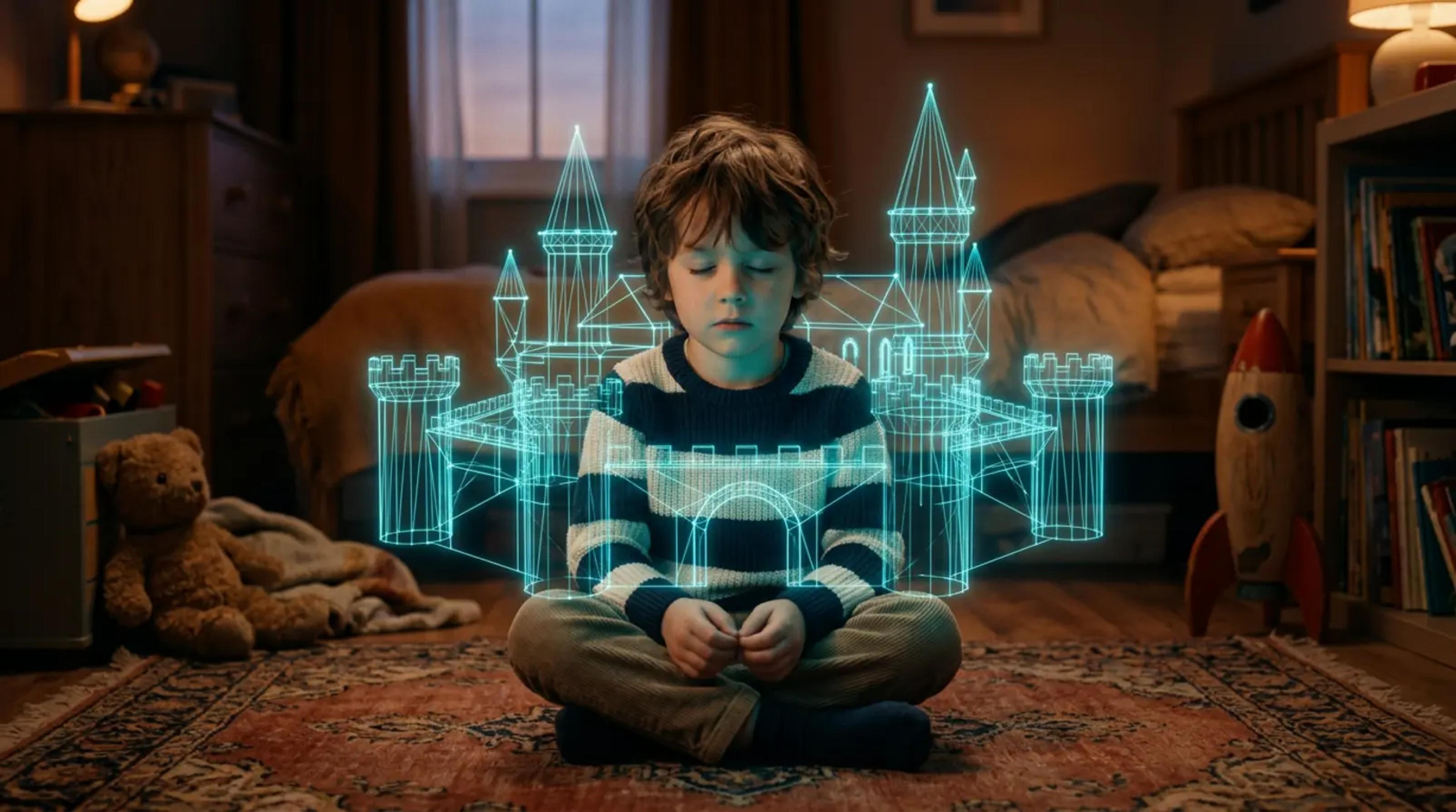
Spatial reasoning isn't just about puzzles; it’s the foundation for geometry, number sense, and abstract problem-solving. To excel in these areas, a child’s brain must be able to perform auditory visualization. This is the process of translating verbal descriptions into detailed mental maps. When a child listens to a story, they are effectively 'rendering' a movie in their mind.
Turn your child's favorite characters into personalized audio adventures. Sign up for free and start your story today!
Get Started FreePlatforms like YouTube Kids or ABCmouse provide 'pre-digested' visuals. While they might be labeled educational, they often do the heavy lifting for the brain. If the screen shows the castle, the child doesn't have to build it. This leads to an atrophy of the mental mapping skills required for higher-level math. By moving , you are giving your child's brain the workout it needs.
Generic audio players like the Toniebox often rely on licensed characters. While fun, the child usually just recalls a visual they’ve already seen on TV. AudioFables changes the game through personalization. By using 'familiar anchors'—your child’s actual teddy bear, their pet cat, or their own bedroom—we reduce the 'recall' cognitive load.
Because the child already knows exactly what their toy looks like, their brain can dedicate 100% of its energy to spatial mapping and mental rotation. They aren't just hearing a story; they are mentally navigating their teddy bear through a 3D solar system or a complex labyrinth. This 'Active Construction' is a high-tier cognitive task that builds the neural pathways for future math success.
Ready to turn bedtime into a brain-boosting adventure? Explore how our creates the perfect environment for open-ended play and cognitive growth.