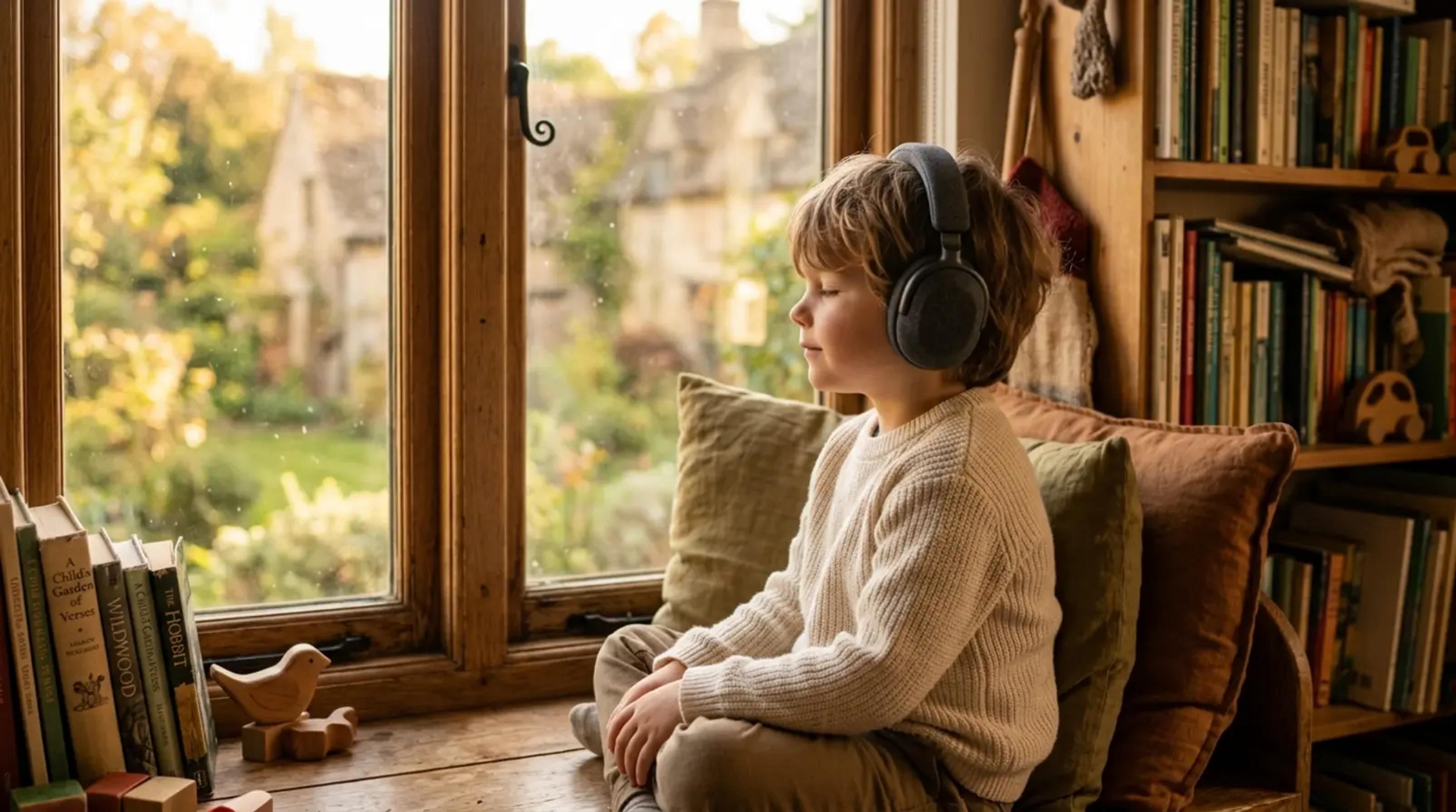
The 'Zero-Frame' Evolution: Why Personalized Audio is the Logical Next Step After Slow TV
•Written by AudioFables Team
Key Takeaways:
► Slow TV is a great first step, but it remains a passive sensory experience.
► Audio storytelling triggers 'Active Construction,' forcing the brain to build its own visuals.
► 'Zero-Frame' entertainment eliminates blue light and the 'dopamine loop' of video content.
► Personalization (AudioFables) creates deeper engagement than generic screen-free players.
If you’ve spent any time on parenting TikTok lately, you’ve likely encountered the 'Low-Stim' movement. Parents are trading the high-octane, neon-colored chaos of shows like Cocomelon for the gentle, rhythmic pacing of 'Slow TV'—think Puffin Rock or Trash Truck. It’s a reaction to what many call 'brain rot': the shortened attention spans and irritability that follow high-dopamine digital consumption.
But as we look toward 2026, the parenting trend is evolving again. We are moving from 'Better TV' to 'Tech-Intentionality.' While Slow TV is a massive improvement, it still keeps children tethered to a glowing rectangle. The next logical step? The 'Zero-Frame' evolution.
Turn your child's favorite characters into personalized audio adventures. Sign up for free and start your story today!
Get Started FreeThe fundamental difference between watching a screen and listening to a story lies in how the brain processes information. When a child watches even the slowest TV show, the imagery is provided for them. This is passive consumption. However, when a child listens to a personalized audio story, they engage in . They must build an 'Internal Movie' in their mind's eye.
This process isn't just magical; it's neurological. Research suggests that auditory storytelling improves inhibitory executive function—the ability to resist impulses and stay focused. By removing the frame, we allow the child's brain to do the heavy lifting, which is the ultimate antidote to the caused by modern media.
Many parents have already embraced screen-free players like the Toniebox or Yoto. These are fantastic tools for creating a . However, they often rely on pre-recorded, static content. AudioFables takes this a step further by introducing deep personalization.
When the hero of the story has your child's name, faces their specific fears, or explores their current favorite hobby, the 'Internal Movie' becomes vivid and deeply personal. This isn't just entertainment; it's a tool for emotional regulation and cognitive growth. Unlike physical figurines, AI-generated personalization allows the story to grow with your child, providing a .
As we move toward a 'Tech-Intentional' future, the goal isn't to ban technology, but to use it to enhance the human experience. By choosing 'Zero-Frame' audio, you are giving your child the space to decompress, imagine, and grow—all without a single blue-light-emitting pixel in sight.