The Theory of Mind Engine: How Personalized Audio Stories Fast-Track Your Child’s Social Intelligence
•Written by AudioFables Team
Key Takeaways:
► Theory of Mind (ToM) is the ability to understand that others have different thoughts and feelings.
► Over-visualized media creates an 'Empathy Gap' by doing the imaginative work for children.
► Auditory visualization acts as a 'gym' for the social brain.
► Personalizing stories with a child's own toys facilitates 'Self-to-Other' mapping, accelerating social intelligence.
Have you ever wondered why your child sometimes struggles to understand why a friend is upset, or why they find it hard to share? This isn't just a phase; it's a developmental milestone called Theory of Mind (ToM). It is the cognitive engine that allows us to realize that the person standing next to us has a completely different set of beliefs, desires, and intentions than our own.
In 2025, researchers are highlighting a growing 'Empathy Gap.' As children consume more high-stimulus, visual-first media, their brains are spending less time 'mentalizing'—the active process of imagining another person's internal state. When the screen shows you exactly what a character looks like and how they feel, the brain takes a shortcut. To build true social intelligence, we need to put that imagination back to work.
Turn your child's favorite characters into personalized audio adventures. Sign up for free and start your story today!
Get Started FreeUnlike tablets or animated shows, audio stories require Auditory Visualization. Without visual cues, a child’s brain must simulate the character’s world. They have to 'see' the character’s facial expression in their mind's eye and 'feel' their hesitation through the tone of the narrator's voice. This is the ultimate workout for developing empathy.
While popular tools like offer great screen-free alternatives, their content is often static. When a child listens to a Disney story for the hundredth time, the character is already fixed. There is no 'cognitive heavy lifting' involved.
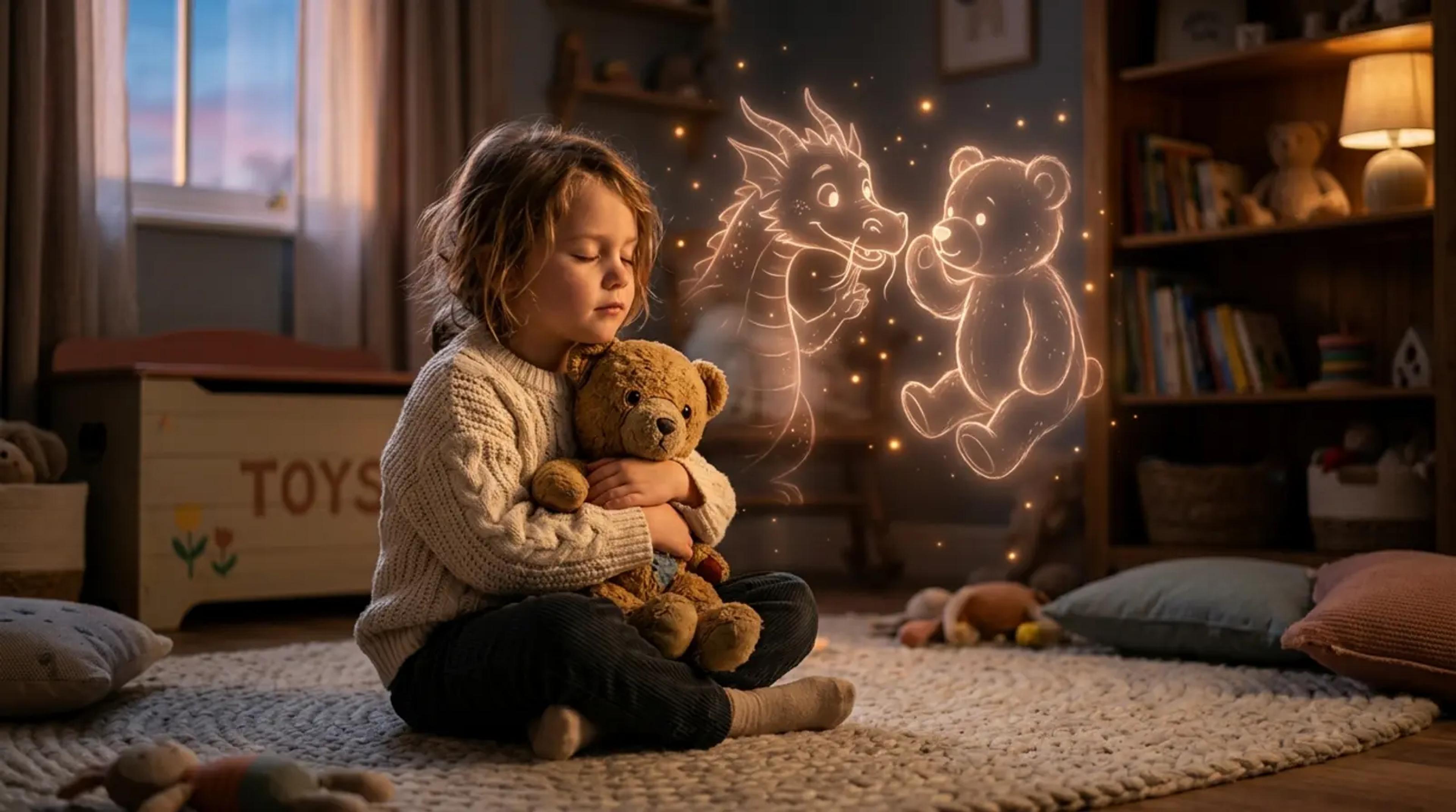
This is where AudioFables changes the game. By using , you can cast your child’s favorite teddy bear or the family dog as a character with a complex personality. Imagine your child hearing their beloved 'Barnaby Bear' express that he feels 'brave but a little bit shy' about going to a new park.
This triggers a neurological process called Self-to-Other mapping. Because the child already has a deep emotional connection to the toy, their brain works harder to understand the toy's 'secret feelings' in the story. This practice translates directly to the playground, helping them navigate complex dynamics like relational aggression or simple conflict resolution.
1. Co-create complex characters: Instead of just 'a happy dragon,' try 'a dragon who is excited but worried about making a mistake.'
2. Use the Hero Reflection Method: After the story, ask: 'Why do you think Barnaby felt that way?' This reinforces the .
3. Script social success: Use stories to model how to join a group at the park, giving them a before they even arrive.
By moving away from passive screen time and toward active auditory engagement, you aren't just filling time—you're building the very foundation of how your child relates to the world. Ready to start? Let's build that social engine together.